

U.S. Military
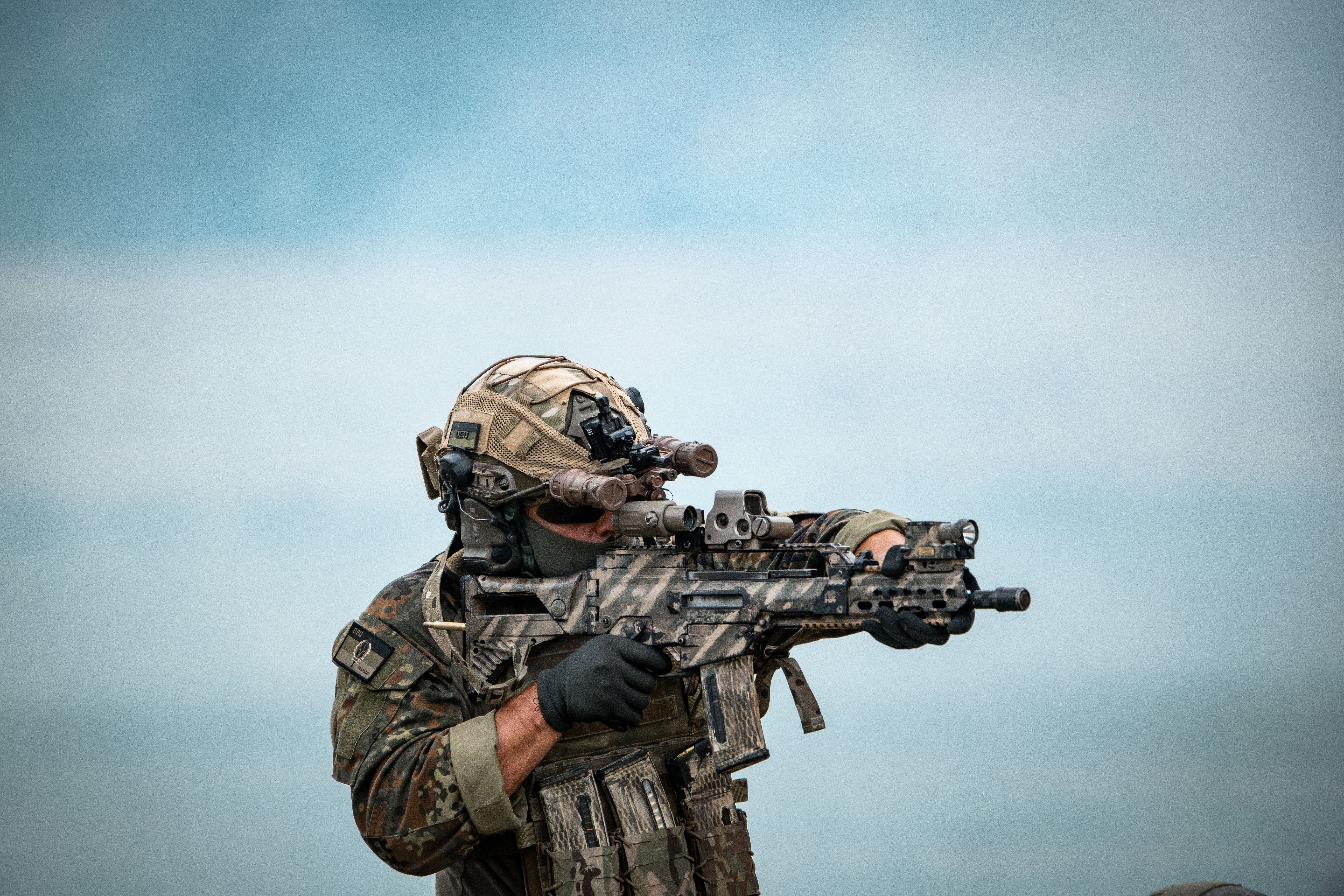
The Arsenal Upgrade: Trump, Hegseth, and Wall Street Titans Mobilize Private Capital to Supercharge U.S. Weapon Stockpiles
The strategic race to rebuild America’s depleted military industrial base took a massive, multi-billion-dollar leap forward in Carlisle, Pennsylvania. Against the backdrop of a grinding regional war in Iran that has severely strained domestic stockpiles of advanced munitions, President Donald Trump, Defense Secretary Pete Hegseth, and the nation’s top military brass convened a high-stakes summit to structurally reshape how the United States funds battlefield technology. The 2026 Pennsylvania Defense and Innovation Summit, hosted at the U.S. Army War College and organized by U.S. Senator Dave McCormick (R-PA), marks the first time the executive branch has gathered elite defense tech innovators, military commanders, and global private equity kings under a single roof. The explicit goal: leveraging private markets to immediately bypass congressional gridlock, expand high-precision manufacturing, and deploy bleeding-edge automation to replenish critical defense reserves. At The Modern Memo, we detail the operational constraints driving the Carlisle summit, the corporate heavyweights pledging capital, and the technological blueprints deployed to revitalize the American defense industrial base. The Material Deficit: The Logistical Shadow of the Iran Conflict The urgency animating the War College summit is driven by a stark, unvarnished physical reality: the U.S. military is expending high-tech munitions faster than its legacy manufacturing pipelines can replace them. The Stockpile Strain: Continuous precision strikes and defensive naval engagements in the Middle East have dramatically reduced U.S. operational inventories of Tomahawk cruise missiles, as well as Patriot (PAC-3) and THAAD missile defense interceptors. The Strategic Timeline: A sobering Pentagon logistics analysis verified that domestic defense contractors will require a minimum of three years to replenish these specific arsenals to pre-conflict baselines. This manufacturing lag has sparked severe anxieties within the Joint Chiefs of Staff regarding America’s firepower readiness in the event of a secondary flashpoint with China over Taiwan. The Budgetary Bottleneck: While President Trump has aggressively proposed a historic $1.5 trillion defense budget for 2027 to fix the shortfall, the massive spending bill remains heavily gridlocked in Congress. The administration is utilizing the Pennsylvania summit to unlock private financing as an emergency stopgap to expand factory floors today. Unveiling the Carlisle Coalition: Wall Street Meets the War Department To supercharge supply chains, the administration has constructed an unprecedented alignment between traditional military procurement and the world’s most powerful financial institutions. The summit features a powerful cadre of national security leaders, including Defense Secretary Pete Hegseth, Joint Chiefs Chairman Gen. Dan Caine, Army Secretary Dan Driscoll, and CIA Director John Ratcliffe. Sitting directly across the table are corporate chiefs representing the absolute apex of global capital and manufacturing logistics: The Finance Guardians: JPMorgan Chase CEO Jamie Dimon and Blackstone President Jon Gray, coordinating private equity syndicates to back high-risk defense infrastructure expansions. The Prime Contractors: Lockheed Martin CEO Jim Taiclet, Boeing CEO Kelly Ortberg, and General Dynamics CEO Phebe Novakovic, aligning legacy assembly lines with new automated sub-contractors. The Disrupted Vanguard: Palantir CTO Shyam Sankar and SpaceX Director Antonio Gracias, spearheading the swift implementation of artificial intelligence, high-speed data networks, and next-generation launch logistics into the core defense grid. The Technology Blueprint: Automation over Bureaucracy Rather than pouring cash into inefficient, multi-year legacy projects, the capital partnerships announced in Carlisle are strictly focused on immediate, modular hardware scalability. Defense Innovator Pledged Investment / Asset Core Operational Objective ZeroEyes $10 Million Allocation Expands artificial intelligence and advanced machine learning research for threat detection. Gecko Robotics 10,000-Sq-Foot Advanced Facility Integrates autonomous robotics directly into manufacturing lines to fast-track hull and structural output. Palantir Technologies Proprietary AI Targeting Frameworks Streamlines raw data sorting to compress the time between target identification and missile deployment. “We have got to supercharge our supply chains to reduce how long it takes for new technology to be ready for widespread production,” explained Jake Loosararian, CEO of Gecko Robotics, emphasizing that the modern battlefield leaves zero room for multi-year regulatory delays. The initial private sector commitments are designed to immediately upgrade Pennsylvania’s industrial corridor, transforming the Commonwealth into a localized manufacturing hub for high-precision components and software-defined defense tools. Final Word The massive convergence of executive power, military command, and Wall Street capital at the U.S. Army War College is the definitive proof that the United States is fundamentally reinventing its national security apparatus to meet the demands of modern warfare. When you look past the standard political theater and focus entirely on the hard data—a critical three-year munitions deficit caused by hot operations in the Middle East, a historic $1.5 trillion defense proposal stalled in the legislature, and the immediate deployment of private capital to build automated, robotic manufacturing infrastructure—you gain an unvarnished view of a total strategic pivot. Quality information replaces the narrative of standard peacetime defense spending with the reality of an active economic mobilization. By cutting through administrative inertia and building a direct pipeline between innovators and high-finance investors, Donald Trump and Pete Hegseth have delivered an unyielding declaration to America’s adversaries: the American industrial engine is waking up, the era of defense supply stagnation is over, and the nation is building the capacity to defend its global interests through sheer technological dominance.

Decapitation Strike: U.S. Military Eliminates Tren de Aragua Leader in Coordinated Venezuela Raid
The global war against transnational organized crime reached a dramatic, kinetic climax deep inside South America. In an extraordinary cross-border operation, U.S. forces executed a precision strike inside Venezuela that successfully eliminated Héctor Rusthenford Guerrero Flores, better known by his street alias “Niño Guerrero,” the notorious kingpin of the ultra-violent Tren de Aragua criminal syndicate. President Donald Trump announced the successful operation on Truth Social, characterizing the mission as a “swift and lethal kinetic strike” that strips safe haven from international syndicates. The cross-border deployment represents a massive geopolitical shift, executed in close coordination with the newly recalibrated Venezuelan government following the forced removal of autocratic leader Nicolás Maduro earlier this year. At The Modern Memo, we break down the operational intelligence behind the strike, the history of the bloodthirsty prison gang, and how the administration leveraged shifting diplomatic dynamics to hunt down America’s most wanted narco-terrorist. The Operation: Blowing Up the Compound The high-stakes mission, carried out by U.S. Southern Command (SOUTHCOM), targeted a heavily fortified hideout used by the gang’s leadership structure. The Lethal Strike: Defense Secretary Pete Hegseth confirmed the operation took place in a remote, southeastern region of Venezuela’s Bolívar state. Trump’s social media announcement included unclassified, overhead surveillance footage capturing the exact moment a precision projectile struck a green-roofed building, instantly engulfing the compound in flames. The Firefight on the Ground: Venezuela’s communications ministry corroborated the timeline, issuing a formal statement confirming that local security forces engaged in fierce firefights with Tren de Aragua militants on the perimeter, culminating in the verified death of the 43-year-old gang lord. The Intelligence Pipeline: According to administration officials, the operation relied on extensive intelligence sharing, with the CIA reportedly mapping the target’s movements. SOUTHCOM Commander General Francis Donovan expressed profound gratitude to the local Venezuelan security services for their tactical support during the combined assault. The Target: Inside the Empire of ‘Niño Guerrero’ Héctor Guerrero Flores was not a standard street-level cartel boss; he was the primary mastermind behind an expansive criminal network that stretched from the lawless interior of South American prisons all the way into major American metropolitan hubs. The Prison Fortress: More than a decade ago, Guerrero assumed total control over the infamously corrupt Tocorón prison in Aragua state. Under his rule, the prison was transformed into a luxurious, fortified command center complete with a pool, a private zoo, a casino, restaurants, and a baseball field, allowing him to run international operations from a lavish private suite. The Transnational Army: Utilizing the mass migration of millions of Venezuelans escaping economic collapse, Tren de Aragua weaponized human smuggling pipelines to embed operatives throughout Peru, Colombia, Chile, and the United States. The gang established an empire built on extortion, contract murder, drug trafficking, and the severe sexual exploitation of women and children. The Federal Hunting License: Late last year, federal prosecutors in New York indicted Guerrero on sweeping racketeering, drug conspiracy, and material support for terrorism charges. The U.S. State Department had placed a $5 million bounty on his head, while the Trump administration formally designated Tren de Aragua as a Foreign Terrorist Organization. The Geopolitical Pivot: The New Alliance in Caracas The ability of the U.S. military to safely drop munitions inside Venezuelan territory marks a complete rewriting of Western Hemisphere defense strategy, made possible by the dramatic collapse of the old regime. The Maduro Arrest Factor: For months, the White House maintained that Tren de Aragua operated under the protection of Venezuelan dictator Nicolás Maduro. That protection permanently dissolved in January, when a daring U.S. military operation whisked Maduro out of the country to face federal drug trafficking charges in the United States. Partnering with Rodríguez: Following Maduro’s capture, the administration backed Acting President Delcy Rodríguez. In exchange for a gradual rollback of paralyzing economic sanctions and the opening of oil reserves, the temporary Venezuelan government has completely aligned its security forces with Washington to aggressively clean out transnational cartels. Retribution for the Victims: In his victory address, Trump tied the execution of Niño Guerrero directly to his domestic borders-and-justice platform. He explicitly dedicated the military strike to the families of American citizens killed in high-profile violent crimes involving undocumented gang members, including 12-year-old Jocelyn Nungaray and 22-year-old Laken Riley. “Tren de Aragua terrorists no longer have safe haven in Venezuela or anywhere else,” Trump wrote. “Under my leadership, we will find these vicious murderers and drug lords anytime, anyplace, and send them to the depths of hell where they belong.” Final Word The precision elimination of Niño Guerrero in his own backyard is the definitive proof that the administration has completely discarded the traditional, passive boundaries of international law enforcement to wage an offensive war against global cartels. When you look past the political noise and look directly at the data—the absolute decapitation of a Foreign Terrorist Organization’s supreme leader, the deployment of U.S. strike packages inside sovereign Venezuelan airspace with the explicit invite of local authorities, and the complete reversal of a decades-long anti-American regime in Caracas—you gain an unvarnished view of raw power politics. Quality information replaces the narrative of “unstoppable migrant gangs” with the reality of targeted military liquidation. It shows that when a rogue criminal empire expands its theater of operations into American suburbs, it forfeits its safety everywhere on earth. By executing a kinetic raid on the compounds of Bolívar state, Washington has delivered an unyielding message to the underworld: no prison wall, no remote jungle, and no foreign border will ever be enough to hide from an American missile.

The Hammer Drops: B-52 Strategic Bombers Conduct “Overland Missions” in Iran Air Superiority Push
In a massive escalation of Operation Epic Fury, the Pentagon confirmed this morning, March 31, 2026, that the United States has begun conducting direct “overland missions” with B-52H Stratofortress strategic bombers deep within Iranian airspace. The move signals a transition from standoff missile strikes to total atmospheric dominance, as U.S. Chairman of the Joint Chiefs of Staff Gen. Dan Caine revealed that over 11,000 strikes have now been carried out against the regime’s infrastructure. At The Modern Memo, we analyze the deployment of the “BUFF” from RAF Fairford, the total collapse of Iranian air defenses, and why the sight of American heavy armor in the skies over Tehran marks the beginning of the end for the regime’s military capability. The Overland Shift: From Standoff to Dominance For the first month of the conflict, U.S. forces primarily relied on long-range cruise missiles and stealth platforms like the B-2 and F-35. The shift to B-52 “overland missions” indicates that the Iranian Integrated Air Defense System (IADS) has been effectively dismantled. Air Superiority Achieved: Gen. Caine noted that the B-52s—massive, non-stealthy bombers—can now fly safely over Iranian territory because the U.S. has achieved total air superiority. With the regime’s radar systems and S-300 batteries neutralized, the B-52 is no longer a target; it is an unstoppable “truck” for precision-guided munitions. The RAF Fairford Launch: On Saturday, March 28, multiple B-52Hs and B-1B Lancers were filmed departing RAF Fairford in the UK, joined by two additional “BUFFs” arriving directly from Barksdale AFB, Louisiana. This massive surge in heavy bomber capacity is designed to provide “persistent loiter” capability—meaning bombers stay over the target zone for hours, striking mobile launchers the moment they are detected. The Weaponry: Precision at Scale While the B-52 is often associated with the “carpet bombing” of the 20th century, the 2026 version is a highly sophisticated digital platform. Heavy Payload: Each B-52 can carry up to 70,000 pounds of mixed ordnance. In the current theater, they are being used to deliver Joint Direct Attack Munitions (JDAMs) and bunker-busters on hardened command centers that survived the initial missile waves. Psychological Warfare: The low-frequency rumble of eight engines over Iranian cities serves a dual purpose. It provides devastating kinetic effects while signaling to the remaining regime loyalists that their “sovereign airspace” is now an American playground. The Results: 90% and Counting The deployment of the B-52s follows President Trump’s earlier announcement that U.S. forces have already neutralized nearly 90% of Iran’s missile launchers. Mopping Up: The bombers are now focused on “Phase 2”: the systematic destruction of the IRGC’s internal security infrastructure and the LEC (Law Enforcement Command) headquarters in provinces like Esfahan. Targeting the Proxy Base: Recent strikes have also extended to Iranian-backed militia bases in Iraq’s Anbar Province, ensuring that the regime cannot use its “proxy shield” to retaliate as its domestic military collapses. Final Word The sight of B-52s flying overland in Iran is the ultimate symbol of “Peace Through Strength.” When you look past the noise of “escalation” warnings and focus on the data—the 11,000 successful strikes and the total suppression of enemy air defenses—you gain a clearer picture of a conflict being won with overwhelming, unapologetic power. Quality information replaces the fear of a “quagmire” with the reality of a surgical, high-altitude dismantling of a rogue state. It allows you to see the B-52 not as a relic of the past, but as the final hammer blow in the restoration of Middle Eastern stability. By choosing to support the total neutralization of the threat, you align your perspective with the reality that true security is only won when the enemy’s sky is no longer their own. Where Facts, Context, and Perspective Matter At The Modern Memo, our goal is simple: to provide clear, well-researched reporting in a media landscape that often feels overwhelming. We focus on substance over sensationalism, and context over commentary. If you value thoughtful analysis, transparent sourcing, and stories that go beyond the headline, we invite you to share our work. Informed conversations start with reliable information, and sharing helps ensure important stories reach a wider audience. Journalism works best when readers engage, question, and participate. By reading and sharing, you’re supporting a more informed public and a healthier media ecosystem. The Modern Memo may be compensated and/or receive an affiliate commission if you click or buy through our links. Featured pricing is subject to change. 📩 Love what you’re reading? Don’t miss a headline! Subscribe to The Modern Memo here!

Operation Epic Fury: U.S. Reinforces the Front as Conflict with Iran Escalates
As the war against the Islamic Republic enters its third decisive week, the United States is significantly expanding its military footprint in the Middle East. Under the direction of Defense Secretary Pete Hegseth, the Pentagon has ordered thousands of Marines and a powerful amphibious strike group to the region—a move that signals Washington’s unwavering commitment to absolute naval dominance and the total reopening of the world’s most critical energy corridors. At The Modern Memo, we analyze the strategic arrival of the USS Tripoli, the mission to secure the Strait of Hormuz, and why this buildup is the necessary response to a regime that has “abandoned all restraint.” The Arrival of the “Floating Fortress” The centerpiece of this reinforcement is the USS Tripoli (LHA-7) and the 31st Marine Expeditionary Unit (MEU). Sailing from Japan, this amphibious assault carrier functions as a mobile airbase, bringing a specialized set of capabilities to Operation Epic Fury. Elite Rapid Response: The MEU consists of roughly 2,200 to 2,500 combat-ready Marines trained for high-intensity raids, amphibious landings, and the securing of strategic infrastructure. Air Superiority from the Sea: The Tripoli carries a lethal contingent of F-35B Lightning II stealth fighters and V-22 Ospreys, providing commanders with “over-the-horizon” strike options that do not depend on land-based foreign runways. Strategic Positioning: Joining the USS Abraham Lincoln and USS Gerald R. Ford strike groups, the Tripoli’s arrival creates one of the most concentrated displays of American naval power in the region since 2003. Securing the Strait: Ending the “Iranian Veto” The primary objective of the increased presence is the contested Strait of Hormuz. Following Iran’s illegal closure of the waterway on March 2, global energy markets have been roiled, and the administration has made it clear that the “veto” on global oil flow will not stand. Clearing the Shoreline: Military analysts suggest the Marines may be utilized for targeted raids on hardened Iranian missile bunkers and drone launch sites along the coastline—targets that are often difficult to eliminate through airstrikes alone. Escort Operations: Treasury Secretary Scott Bessent and Defense Secretary Hegseth have both signaled that U.S. Navy escorts for commercial tankers could begin “very soon.” The addition of the Tripoli’s ESG (Expeditionary Strike Group) provides the necessary Aegis-class protection to shield merchant ships from Iranian “suicide” boats and cruise missiles. Kharg Island Warning: President Trump has already confirmed that U.S. forces “obliterated” military sites on Kharg Island. The deployment of ground-capable Marines serves as a final warning: should the interference continue, the regime’s critical oil infrastructure will be next. A Posture of Strength Amidst Domestic Strain This surge in Middle Eastern forces comes despite the ongoing political gridlock in Washington regarding the Department of Homeland Security (DHS) shutdown. While critics point to the strain on domestic agencies, the administration maintains that national security is a global, indivisible priority. Decisive Command: Secretary Hegseth has remained focused on the mission, noting that over 15,000 enemy targets have been struck since the war began. “We have a plan for every option,” Hegseth told reporters, emphasizing that the U.S. will not allow the Strait to remain a contested zone. The Deterrence Factor: By moving ground-capable forces into the theater, the U.S. is signaling that it is prepared for a wider confrontation if Tehran continues its asymmetric attacks on American assets and allies. Final Word The deployment of the 31st MEU is a cold, calculated message to Tehran: the era of “strategic patience” has ended. When you look past the noise of regional escalation and focus on the data—the 2,500 Marines, the F-35B squadrons, and the systematic dismantling of the Iranian Navy—you gain a clearer picture of an administration that prioritizes results over rhetoric. Quality information replaces the fear of a “forever war” with the clarity of a targeted, high-tech campaign designed to restore order to the global commons. It allows you to see this buildup not as an act of aggression, but as the essential enforcement of maritime law. By choosing to support this decisive posture, you align your perspective with the reality that a secure world is only possible through undisputed strength. Where Facts, Context, and Perspective Matter At The Modern Memo, our goal is simple: to provide clear, well-researched reporting in a media landscape that often feels overwhelming. We focus on substance over sensationalism, and context over commentary. If you value thoughtful analysis, transparent sourcing, and stories that go beyond the headline, we invite you to share our work. Informed conversations start with reliable information, and sharing helps ensure important stories reach a wider audience. Journalism works best when readers engage, question, and participate. By reading and sharing, you’re supporting a more informed public and a healthier media ecosystem. The Modern Memo may be compensated and/or receive an affiliate commission if you click or buy through our links. Featured pricing is subject to change. 📩 Love what you’re reading? Don’t miss a headline! Subscribe to The Modern Memo here!