


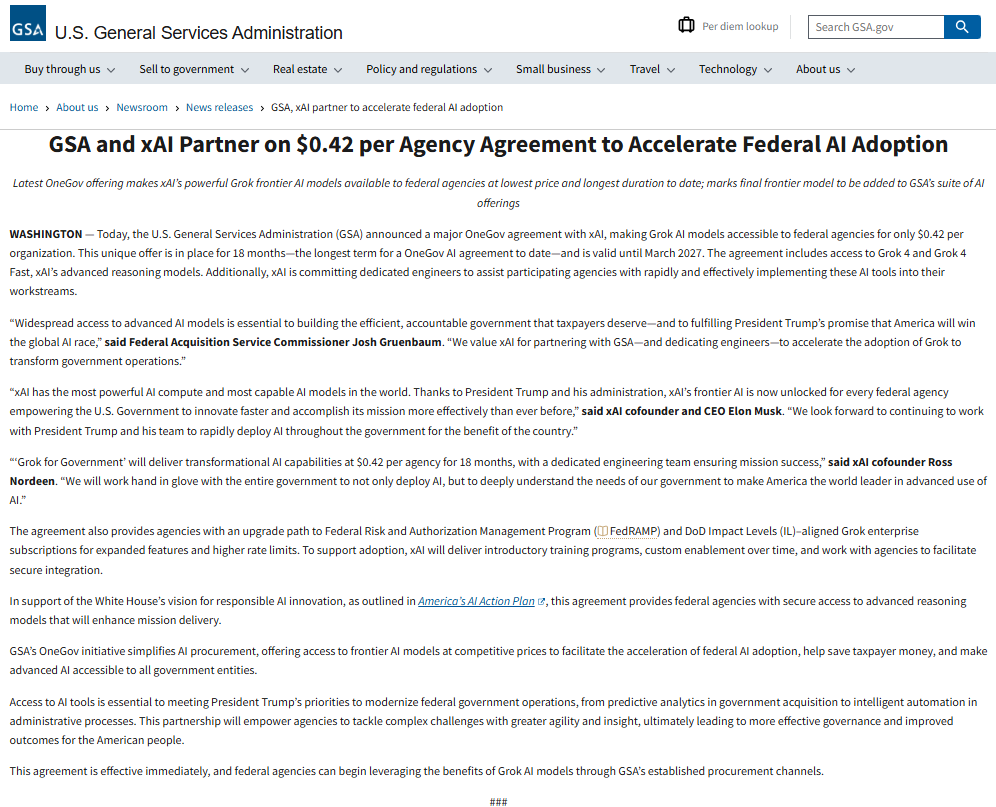
The Trump administration has signed a new agreement with Elon Musk’s company xAI to bring advanced artificial intelligence into federal operations. Through the deal with the General Services Administration (GSA), agencies across the government will gain access to xAI’s Grok 4 and Grok 4 Fast models.
Leaders on the Record
The new partnership between the Trump admin and xAI is being framed as both a government modernization effort and a bid for U.S. leadership in artificial intelligence.
Federal Acquisition Service Commissioner Josh Gruenbaum tied the deal directly to government accountability and competitiveness. “Widespread access to advanced AI models is essential to building the efficient, accountable government that taxpayers deserve—and to fulfilling President Trump’s promise that America will win the global AI race,” he said. Gruenbaum added that GSA values xAI for “partnering with GSA—and dedicating engineers—to accelerate the adoption of Grok to transform government operations.”
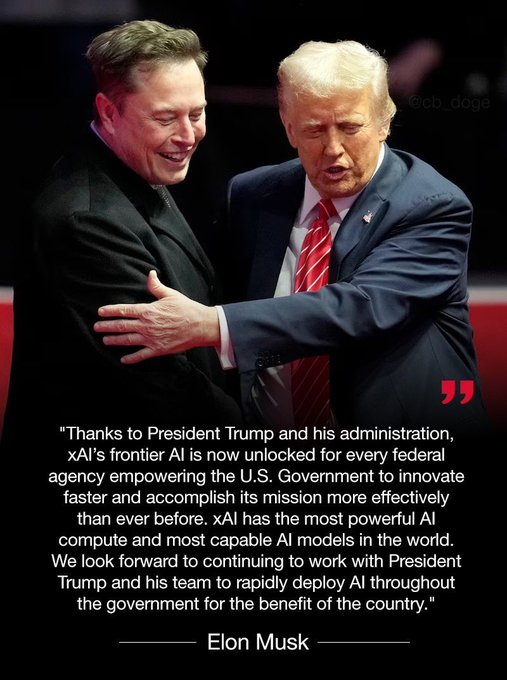
On the industry side, xAI cofounder and CEO Elon Musk stressed the scope of what the agreement makes possible. “xAI has the most powerful AI compute and most capable AI models in the world. Thanks to President Trump and his administration, xAI’s frontier AI is now unlocked for every federal agency empowering the U.S. Government to innovate faster and accomplish its mission more effectively than ever before,” Musk said.
Fellow xAI cofounder Ross Nordeen focused on cost and collaboration. “‘Grok for Government’ will deliver transformational AI capabilities at $0.42 per agency for 18 months, with a dedicated engineering team ensuring mission success,” Nordeen explained. “We will work hand in glove with the entire government to not only deploy AI, but to deeply understand the needs of our government to make America the world leader in advanced use of AI.” (MORE NEWS: AI Is Taking Entry-Level Jobs and Shaking Up the Workforce)
What the Partnership Aims to Do
This move is about adoption at scale. Agencies need tools that draft, summarize, search, and reason across complex information. They need faster answers for citizens and clearer guidance for staff. They also need consistent technology so each office is not reinventing the wheel. A shared platform can cut duplication, reduce delays, and raise the baseline for service quality.
At the same time, agencies want help during rollout. They need engineers who can integrate systems, train teams, and troubleshoot in real time. The plan puts technical support alongside the tools so offices can move quickly without getting stuck in setup. (MORE NEWS: The Dark Side of AI Chatbots: A Threat to Fragile Minds)
Why This Matters Now
Other nations are investing heavily in AI. The Trump admin wants to keep pace and set standards. Modern government runs on information. If the tools to sort, draft, and decide are faster and more accurate, the work moves faster and the outcomes improve. That is true for benefits, permits, inspections, grants, and more.
This partnership also signals a practical shift. Instead of small pilots that never scale, the plan aims at broad access. When the same core capabilities are available across agencies, good ideas spread faster and cost less to repeat.
How Agencies Could Use It
Start with the inbox. AI can triage citizen questions, propose replies, and surface policy references so staff can finalize answers in minutes. Case teams can summarize long files and highlight the few lines that matter most. Program analysts can scan reports for trends and anomalies. Field offices can translate notices and instructions so more people understand them on the first read.
Managers gain time back. Drafts of memos, briefings, and forms arrive in seconds. Teams still review and approve. But they start from a strong first pass instead of a blank page. Over time, staff can build playbooks for recurring tasks so the next request is even faster.
Safeguards, Not Surprises
Speed alone is not the goal. Agencies must protect sensitive data. They must log how tools are used. They must keep a human in the loop for decisions that affect people’s lives. Good oversight includes access controls, audit trails, testing, and clear guidance about when to accept, edit, or reject an AI suggestion.
Clarity matters for the public, too. People should know that the government uses AI to draft and sort, while humans make the final calls. Straightforward disclosures build trust and reduce confusion. Strong privacy practices do the same.
What Success Looks Like
Success shows up in fewer backlogs and faster cycle times. It shows up when citizens get clearer answers and fewer repeat requests. Additionally, in staff surveys, teams report spending more time on judgment and less time on routine drafting.
It also shows up in budgets. Shared tools and reusable patterns reduce duplicative contracts and one-off builds. Agencies get more value from each dollar because they start with the same core capability and adapt it to their mission.
What Comes Next
The fastest path is simple: pick a handful of high-volume tasks, set clear guardrails, and measure results. Train teams early and often. Capture what works in short playbooks. Share those playbooks across offices so others can use them on day one.
As the tools mature, add more use cases. Keep the same rules: protect data, log usage, review outputs, and improve based on feedback. With that rhythm, agencies can move quickly and still maintain control.
The Bottom Line
This deal is more than a contract. It changes how the federal government approaches artificial intelligence. By putting advanced models directly into agency workflows, the administration is trying to modernize operations, reduce waste, and position the U.S. to lead in a fast-moving global race.
Whether the plan succeeds will depend on execution: securing sensitive data, training employees, and integrating new tools with old systems. If agencies can balance speed with safeguards, they stand to deliver faster, clearer, and more reliable services to the public. If not, the effort risks becoming another big promise weighed down by bureaucracy.
Either way, the partnership signals that Washington is serious about AI — and that the government wants to set the pace rather than follow it.
Unmask the Narrative. Rip Through the Lies. Spread the Truth.
At The Modern Memo, we don’t polish propaganda — we tear it to shreds.
The corporate press censors, spins, and sugarcoats. We don’t.
If you’re tired of being misled, silenced, and spoon-fed fiction, help us expose what they try to hide.
Truth matters — but only if it’s heard.
So share this. Shake the silence. And remind the powerful they don’t own the story.
