

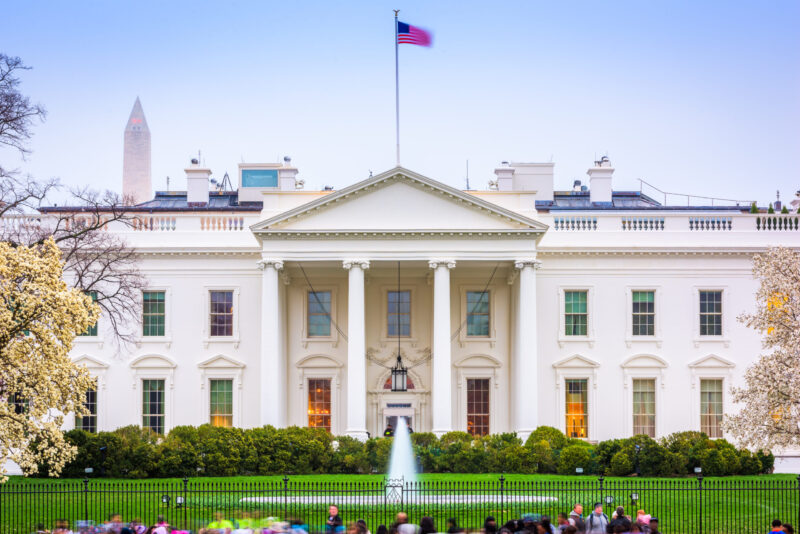
A Major Change at the White House
President Donald Trump has begun tearing down the East Wing of the White House to make room for a new 90,000-square-foot ballroom. The project has already started, and demolition crews are clearing parts of the historic structure. The move has raised questions about preservation laws, federal permits, and who actually has the authority to approve such a major project.
No Permit Required for the Project
The White House sits on federal property managed directly by the Executive Office of the President (EOP). Because of that, the President can authorize construction or demolition without going through outside agencies.
Unlike most federal buildings, the White House is not managed by the General Services Administration or the District of Columbia’s permit office. The President’s office acts as both property owner and regulator because he is the head of the Executive Branch of government. That means the work can move forward without outside permits or reviews.
Why the National Park Service Isn’t Involved
Many assume the National Park Service (NPS) oversees all White House changes because it manages nearby landmarks such as Lafayette Square and the Ellipse. However, NPS only becomes involved when federal funds are used. (MORE NEWS: FBI Probes Hunting Stand Near Trump’s Air Force One Area)
In this case, the ballroom construction is privately funded, removing the NPS from the process entirely, although the President has been consulting with them since the beginning, per their statement. The President and private donors are covering the cost, so no federal money is being spent. That distinction keeps the project outside the reach of most preservation and environmental-review laws.
Exemptions Under the National Historic Preservation Act
The National Historic Preservation Act of 1966 (NHPA) normally protects historic properties by requiring federal agencies to review projects that could affect the National Register of Historic Places.
But here’s the key detail: the White House, the U.S. Capitol, the Supreme Court, and all their related buildings and grounds are exempt from that review process. Congress carved out these constitutional buildings decades ago, leaving them free from the NHPA’s Section 106 requirements.
So while the White House is one of America’s most iconic historic sites, it’s legally exempt from the standard preservation process that governs most federal properties.
The Role of the NCPC
Even though no permit is required, one agency still plays a small part — the National Capital Planning Commission (NCPC). This body oversees federal development in Washington, D.C. The NCPC must review and approve new construction, but it does not oversee demolition.
NCPC Chair Will Scharf said about the project:
“It is in fact the case that this commission does not have jurisdiction — and it has long denied that it has jurisdiction — over demolition and site preparation work for federal buildings on federal property. What we deal with is essentially construction — vertical build.”
That means Trump’s team can legally demolish the East Wing before submitting final designs for the new ballroom. Once the building plans are complete, they will be reviewed by the NCPC. Most commissioners were appointed by Trump, so approval is expected to move quickly.
What the New Ballroom Will Look Like
The proposed ballroom is expected to be the largest indoor space ever built within the White House complex. According to the White House Statement, “theme and architectural heritage will be almost identical” to the White House itself. Concept renderings show a grand event hall with marble floors, gold trim, and chandeliers imported from Italy. (MORE NEWS: John Bolton Pleads Not Guilty to Classified Documents Charges)
Officials say the space will be used for state dinners, receptions, and formal events. The President describes it as a “modernization,” not an expansion.
A Long History of White House Changes
The East Wing demolition is only the latest in a long line of White House transformations. Over more than a century, presidents have shaped and reshaped the building to fit their needs.
- Theodore Roosevelt oversaw the construction of the West Wing in 1902, separating the family residence from the offices.
- William Howard Taft added the first Oval Office in 1909, modeled after the Blue Room’s graceful oval shape.
- Calvin Coolidge renovated the third floor and replaced the roof with a new steel-framed attic story in 1927.
- Franklin D. Roosevelt built the East Wing in 1942 and installed an indoor swimming pool in 1933 to treat his polio.
- Harry S. Truman completely gutted and rebuilt the White House interior between 1948 and 1952 because it was structurally unsound. He also installed the first bowling alley in 1947, a small two-lane setup in the basement.
- Richard Nixon added another bowling alley in 1969 under the North Portico, creating the one still used today.
- Gerald Ford built an outdoor swimming pool on the South Grounds in 1975 for family use.
- Barack Obama converted the tennis court into a full basketball court in 2009. Also, made $376 million in renovations on the taxpayer’s dime.
Each administration has left a visible mark on the property, blending function, symbolism, and personal style.
A CNN report from 2010:
$376 million White House renovation during the Obama Administration.
Where was the Democrat outrage then? pic.twitter.com/MvLVDFcTru
— Christian Collins (@CollinsforTX) October 22, 2025
What Happens Next
Demolition is expected to continue through winter, with construction on the new ballroom starting soon after. The full project could take up to three years. Tours of the East Wing are suspended, and sections of the South Grounds are closed to staff and the public.
Meanwhile, daily operations continue inside the main residence and West Wing. Officials insist that safety standards are being met and that the new structure will complement the White House’s classic style.
Final Thoughts
The East Wing demolition marks an exciting new chapter for the White House. The addition of a state-of-the-art ballroom will enhance the Executive Residence’s ability to host world leaders, dignitaries, and major diplomatic events with unmatched elegance. Designed to reflect the building’s historic character while embracing modern functionality, the new space is expected to become one of Washington’s premier venues for official gatherings.
The ballroom is a fitting upgrade for America’s most iconic residence — a place where diplomacy, history, and hospitality meet. The project will give future presidents a first-class facility to welcome guests from around the globe, strengthening the White House’s role as both a seat of power and a symbol of national pride. This expansion continues the tradition of adapting the White House to meet the evolving needs of the presidency and the nation.
Cut Through the Noise. Slice Through the Lies. Share the Truth.
At The Modern Memo, we don’t tiptoe around the narrative—we swing a machete through it. The mainstream won’t say it, so we will.
If you’re tired of spin, censorship, and sugar-coated headlines, help us rip the cover off stories that matter. Share this article. Wake people up. Give a voice to the truth the powerful want buried.
This fight isn’t just ours—it’s yours. Join us in exposing what they won’t tell you. America needs bold truth-tellers, and that means you.
