
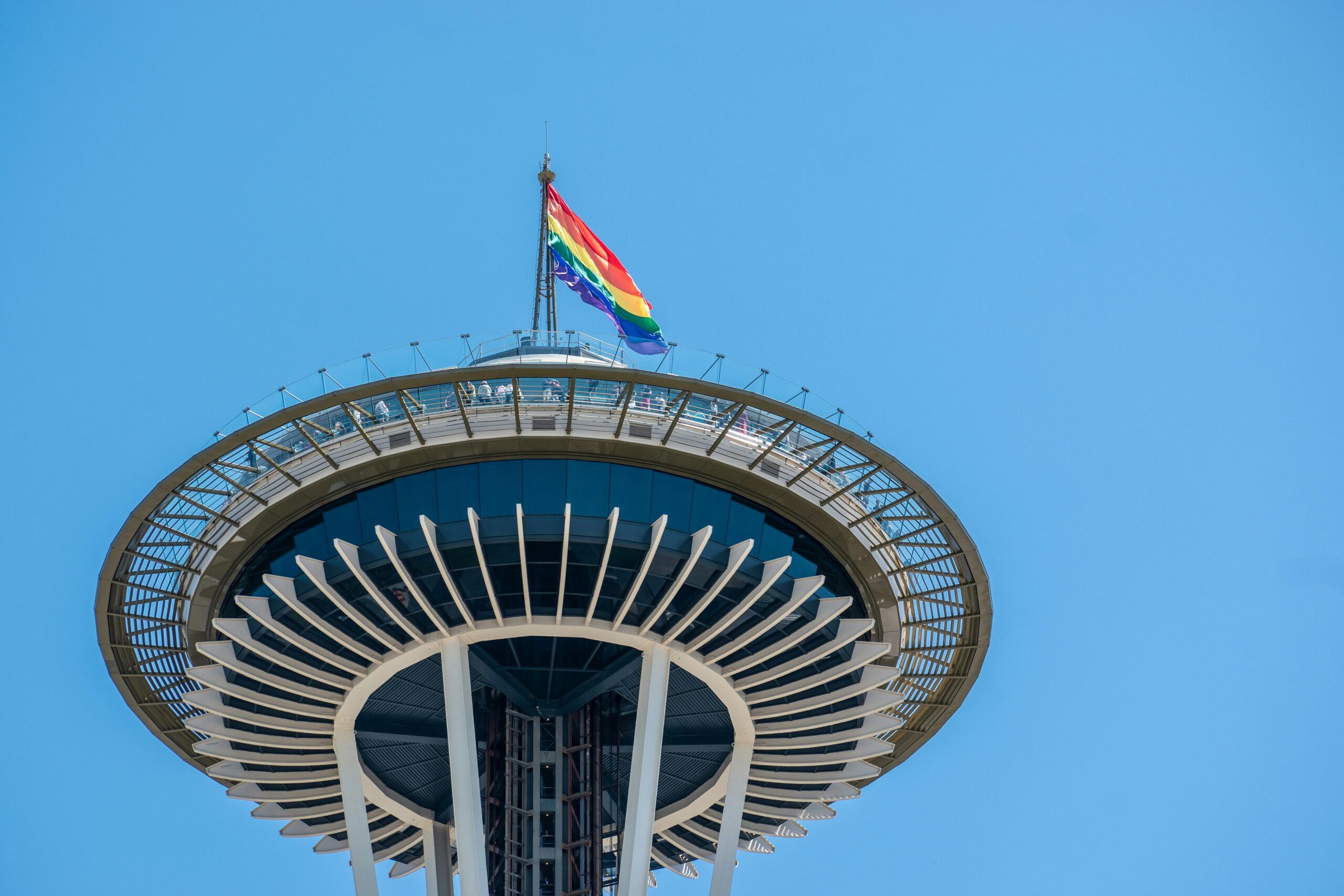
The annual Seattle Pride Parade—a massive cornerstone of the Pacific Northwest’s cultural landscape—has dissolved into a localized storm of public anger and online fury. Following a weekend of sweeping festivities that brought an estimated 300,000 spectators to the downtown corridor, a series of viral videos showcasing entirely nude participants marching along the parade route has ignited a fierce national conversation over public indecency, municipal ordinance loopholes, and the boundaries of family-friendly events.
While organizers celebrated the parade as a massive victory for visibility, critics and parent advocacy groups have slammed the display as “unacceptable pandemonium,” demanding that city leadership enforce strict nudity restrictions when events are explicitly marketed to families and young children.
At The Modern Memo, we break down the operational layout of the 2026 Seattle Pride Parade, the unique municipal legal loopholes that protect public nudity in the state of Washington, and the escalating political fallout hitting City Hall.
The Parade Layout: A Million-Dollar Rainbow Footprint
The incident occurred during the main procession of the Seattle Pride Parade, an event that has grown into one of the largest and most well-funded LGBTQ+ celebrations in the United States.
-
The Procession Metrics: The parade featured more than 250 distinct contingents, blending grassroots queer activist networks, drag performers, and non-profit organizations directly with massive corporate sponsors.
-
The Route: The march traveled along its traditional downtown corridor, starting at Westlake Park and terminating at the Seattle Center. Because the event coincided with a high-profile World Cup match weekend in the city, downtown Seattle was packed with an unprecedented volume of both local families and international tourists.
-
The Conflict Points: The specific flashpoint that triggered the online backlash occurred along the main spectator barriers, where several groups of entirely nude marchers—some wearing only shoes and body paint—pranced and danced directly past families with toddlers and young children seated on the curbs.
The Legal Loophole: Why Seattle Police Can’t Intervene
As outrage flooded social media channels, with critics demanding to know why local law enforcement failed to execute immediate arrests for public indecency, legal experts pointed directly to the distinct architecture of Washington state law.
-
The Municipal Code: Under Seattle Municipal Code (SMC) 12A.10.070, public nudity, in and of itself, is not a crime. For a person to be charged with lewd conduct, the state must prove beyond a reasonable doubt that the individual intentionally performed a lewd act in a public place with the explicit intent to cause affront or alarm, or for the purpose of sexual gratification.
-
The Expressive Shield: The Washington State Supreme Court has historically maintained a highly permissive stance on public nudity, routinely classifying non-sexual nudity during political protests, performance art, and civic parades—such as the annual Fremont Solstice Cyclists—as a protected form of free expression.
-
The Hands-Tied Directive: Because the nude marchers at the Pride parade were participating within the boundaries of an approved, permitted cultural expression and were not engaged in explicit sexual behavior, the Seattle Police Department’s hands were legally tied. Officers stationed along the route had zero statutory authority to intervene or order the marchers to cover up.
The Cultural Chasm: Freedom of Expression vs. Child Protection
The failure of the legal code to restrict the display has opened a massive, unyielding cultural chasm between traditional progressive activists and a growing coalition of moderate residents and parental rights organizations.
-
The Case for Radical Acceptance: Proponents of the display argue that public nudity has been an integral, historical component of the Pride movement since the Stonewall Riots, symbolizing a radical shedding of societal shame and a celebration of body positivity. Organizers emphasize that Pride is fundamentally an adult-centric liberation march at its core, and argue that parents who choose to bring children to the downtown route bear the primary responsibility for vetting the environment beforehand.
-
The Case for Common-Sense Boundaries: Conversely, parental advocacy groups counter that the event’s own marketing loops create a dangerous double standard. They point out that Seattle Pride actively promotes the parade as a “safe, inclusive, and family-friendly space for all ages,” complete with designated youth zones. Critics argue that inviting families to an event while simultaneously exposing children to adult nudity is a profound breach of public trust that undermines the broader goals of community inclusion.
Final Word
The pandemonium surrounding the Seattle Pride Parade is the definitive proof that the progressive movement’s commitment to absolute, unconstrained individual expression is on a direct collision course with the baseline boundaries of public child protection. When you look past the standard online screaming matches and focus entirely on the hard data—a major civic parade utilizing municipal codes to shield adult nudity in public corridors, hundreds of families caught in a structural mismatch between marketing and reality, and local police legally barred from enforcing baseline decency standards—you gain an unvarnished view of a city struggling to govern its own cultural landscape.
Quality information replaces the theatrical outrage with the cold mechanics of statutory law. It shows that while activists view the display as a triumph of bodily liberation, the reality on the ground is a fracturing of the civic consensus. By refusing to establish common-sense, age-appropriate boundaries for public streets, municipal leadership has guaranteed that the debate over Pride will no longer be focused on civil rights, but on the defense of the innocence of the children watching from the curb.
