

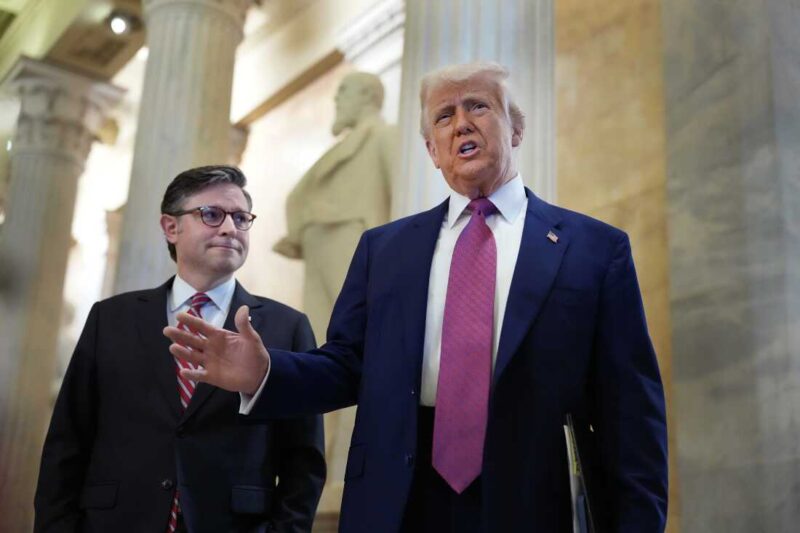
President Donald Trump has called a high-stakes meeting with leaders from both parties as a possible government shutdown edges closer. He canceled a previous meeting with congressional Democrats, insisting their demands were “unserious and ridiculous.” As the September 30 funding deadline nears, the White House and Capitol Hill scramble to find common ground.
Who Will Attend the Meeting
Trump will meet with:
- Senate Minority Leader Chuck Schumer (D-N.Y.)
- House Minority Leader Hakeem Jeffries (D-N.Y.)
- House Speaker Mike Johnson (R-La.)
- Senate Majority Leader John Thune (R-S.D.)
These leaders will gather at the White House to negotiate a path forward and avert a government shutdown. Schumer and Jeffries released a joint statement confirming the rescheduled meeting and reaffirming their willingness to meet at “any time and with anyone.” (MORE NEWS: Trump Admin and Musk’s xAI Launch Federal AI Partnership)

Why the Earlier Meeting Fell Apart
The meeting that Trump had planned with Democrats last week was canceled after he accused them of pushing “radical Left policies” and making unreasonable demands. At that time, he said that a productive discussion would not be possible under current conditions.
Meanwhile, Democrats had criticized a short-term funding extension proposed by Republicans as “dirty” because of policy riders and healthcare cuts embedded in it. They warned that a shutdown could disrupt hospitals and other essential services.
Speaker Johnson defended the earlier cancellation, calling it premature and arguing that Republicans must first do the “basic governing work” of keeping the government open before engaging in major negotiations.
Stakes and Timeline
If Congress and the White House fail to reach a deal by midnight ET on September 30, a partial government shutdown would begin. Many federal services and programs would face interruption, from staffing and payments to federal agencies.
Time is running out. The Senate is scheduled to reconvene on September 29 after the Jewish New Year break. The House, however, is expected to remain in recess until the deadline looms. That gap could limit the flexibility each chamber has to respond at the last minute.
Key Points of Contention
Healthcare and Medicaid funding
A major sticking point is how the funding proposals treat healthcare policy. Trump and Republicans are fighting to keep government funding lean, rejecting Democrat demands to fund healthcare for illegal immigrants through Medicaid. Democrats’ push for over $1 trillion in new spending, including Obamacare handouts, puts a heavy burden on American families. The GOP’s smart cuts, like slashing $1 trillion in Medicaid waste, show they’re focused on putting citizens first. (MORE NEWS: James Comey Indicted for False Statements, Obstruction)
House Speaker Mike Johnson says, “What Chuck Schumer is demanding…He wants to reinstate free health care for illegal aliens paid for by American taxpayers. We are not doing that. We can’t do that. That’s just one of the crazy things he’s requested.”
President Trump will now bring the four top congressional leaders to the White House in an effort to avoid the potential Tuesday night government shutdown.
“What Chuck Schumer is demanding…He wants to reinstate free health care for illegal aliens paid for by American… pic.twitter.com/zpXYZCPVYC
— DeVory Darkins (@devorydarkins) September 28, 2025
Policy riders and “poison pill” provisions
Republicans add practical rules to funding bills to protect taxpayer money, like limiting funds for controversial programs. Democrats call these “poison pills,” but they’re just common-sense steps to keep spending in check. While the GOP keeps things focused, Democrats demand pricey extras like foreign aid that inflate the budget.
Political responsibility and public pressure
Republicans are pushing a straightforward plan to avoid a shutdown and keep America’s priorities first. Democrats try to blame the GOP, but their $1.5 trillion wish list is what’s holding things up. Voters are backing the GOP’s focus on fiscal responsibility over Democratic political games.
Lessons From Past Shutdowns
Americans have seen shutdown battles before, and history offers important lessons. The most recent major shutdown came in late 2018 and lasted 35 days, the longest in U.S. history. Hundreds of thousands of federal workers went without pay, many relying on food banks and community support.
In earlier shutdowns, the effects were similar: suspended paychecks, reduced services, and public frustration. While essential workers like air traffic controllers and TSA staff remained on duty, the lack of paychecks strained morale and daily life. Public opinion often turned quickly against those viewed as responsible for the impasse.
This history is a reminder to both parties that the political costs of a shutdown can be steep. Leaders know that voters may punish them at the ballot box for failing to keep the government running.
What to Watch Next
- Progress at the meeting — Whether the Oval Office discussion yields a framework or agreement will be critical.
- Legislative movement — Even if the meeting ends positively, legislation must pass both chambers before time runs out.
- Statements after the meeting — The tone and messaging from Trump and congressional leaders may signal who holds leverage.
- Last-minute amendments or compromises — In past shutdown fights, final deals emerged in the eleventh hour.
What This Means for Americans
A government shutdown could delay federal payments, furlough workers, and slow critical services. Federal employees, military families, and contractors would be among the first to feel the impact. Many public-facing functions, such as national parks, regulatory agencies, and services relying on federal funding, would face disruption.
The economic impact can ripple far beyond Washington. Delayed contracts, reduced consumer confidence, and missed paychecks can drag on local economies across the country. Businesses that rely on government services or federal workers as customers often see an immediate downturn.
Beyond the financial cost, shutdowns erode trust in government. Americans expect their leaders to keep the basic machinery of government functioning. Each time the system stalls, confidence weakens and frustration grows.
Final Word
As the deadline approaches, Trump and congressional leaders face a defining moment at the White House. The talks carry both the risk of a costly stalemate and the chance for a breakthrough. What emerges from this meeting will decide not only whether the government stays open, but also which party convinces Americans it has the stronger vision for the nation’s future.
Forget the Headlines. Challenge the Script. Deliver the Truth.
At The Modern Memo, we don’t tiptoe through talking points — we swing a machete through the media’s favorite lies.
They protect power. We confront it.
If you’re sick of censorship, narrative control, and being told what to think — stand with us.
Share the story. Wake the people.
Because truth dies in silence — and you weren’t made to stay quiet.
