



Border Crossings Remain at Historic Lows as Drug Seizures Surge Under Trump Enforcement Push
Illegal border crossings stayed near historic lows in the latest monthly data released by Customs and Border Protection, even as agents reported a sharp increase in drug seizures — a combination officials say reflects both a secured border and stepped-up enforcement against cartel trafficking networks. CBP data show 31,626 illegal border crossers were apprehended nationwide last month, up slightly from the prior year but down by more than 173,000 compared to the same month in 2024, before the current enforcement posture took hold. CBP Commissioner Rodney Scott credited the numbers to sustained policy enforcement. “Leadership and policy matter,” Scott said. “When laws are enforced, fewer people will break the law.” Zero Releases, Rising Drug Seizures The Department of Homeland Security also touted a 14th consecutive month of zero releases of illegal border crossers into the interior at the southwest border. At the same time, agents say they’re seeing more contraband as smuggling networks adapt. CBP seizures of cocaine, methamphetamine, heroin, fentanyl and marijuana combined increased 49% compared to the year before, and are up 57% for the fiscal year to date. Not Without Scrutiny The picture isn’t entirely uniform. Watchdog groups note that a small number of unaccompanied minors continue to be released into the country each month despite the administration’s “zero releases” framing, and northern border crossings have ticked up modestly compared to earlier in the year, though they remain far below levels seen during the previous administration. Supporters of the administration’s approach argue the broader trend line — a border security posture that has produced the lowest sustained crossing numbers in CBP’s recorded history — speaks for itself, even as critics continue to press for more transparency around enforcement statistics and the treatment of migrant families still making their way through the system. This story is developing.

Inflation Cools More Than Expected as Gas Prices Tumble, Giving Trump Economy a Boost
Fresh inflation data released this month showed consumer prices cooling by more than economists had forecast, driven largely by a sharp drop in energy costs — a welcome data point for the Trump administration as it continues to make the case that its economic policies are bringing prices under control. The Consumer Price Index fell 0.4% month-over-month in June, pulling the year-over-year inflation rate down to 3.5% from 4.2% in May, with the decline driven by a sharp drop in energy prices and flat growth in core components. Gasoline prices were the biggest driver of the monthly decline, while core prices — which strip out food and energy — were unchanged for the month and up 2.6% over the past year. A Mixed Labor Picture The inflation news arrived alongside a more mixed jobs report. June payrolls rose by just 57,000, well below the 100,000 consensus forecast, with revisions stripping 74,000 jobs out of the prior two months’ totals. The unemployment rate nonetheless ticked down slightly to 4.2%, though economists note that’s partly a reflection of fewer people participating in the labor force rather than a surge in hiring. Corporate earnings, meanwhile, have come in strong. Major banks reported better-than-expected results in the second quarter, boosted by strong trading and investment banking revenue, with analysts expecting S&P 500 earnings to grow by roughly 23% year-over-year — which would mark a second consecutive quarter of 20%-plus growth. What It Means Going Forward The cooling inflation numbers give the Federal Reserve more room to maneuver as it weighs interest rate policy at its meeting later this month. Administration officials have pointed to the falling energy prices and slowing inflation as validation of the president’s energy and trade policies, even as they acknowledge the labor market has room to strengthen further. Economists caution that further disinflation will hinge partly on whether the recent ceasefire in the Middle East holds, since renewed conflict could send energy prices back up. This story is developing.

Trump Administration Locks in Historic Nuclear Energy Deal With Saudi Arabia, Handing US Firms the Lead Role
The Trump administration signed a landmark civil nuclear cooperation agreement with Saudi Arabia this week, a deal officials say will lock in American companies as the kingdom’s exclusive partner for a nuclear energy buildout expected to be worth billions of dollars over several decades. Energy Secretary Chris Wright signed the agreement alongside Saudi Energy Minister Prince Abdulaziz bin Salman, with the Department of Energy touting it as a win for American jobs, energy dominance, and strategic influence in the Middle East. The agreement builds on President Trump’s executive order on deploying advanced nuclear reactor technologies and specifically supports an expansion of international partners for U.S. civil nuclear cooperation. What’s in the Deal The agreement, known as a “123 agreement” under the Atomic Energy Act, is expected to last 30 years and gives American firms — most notably legacy nuclear giant Westinghouse — priority access to build and supply Saudi Arabia’s civilian reactor program. It also grants Saudi Arabia a pathway toward enriching its own nuclear fuel domestically. The Department of Energy says the partnership will expand American nuclear technology exports, create high-paying U.S. jobs, strengthen America’s energy and national security posture, and deepen the strategic partnership between the U.S. and Saudi Arabia — while reinforcing global nonproliferation standards. “These agreements reflect our two nations’ shared commitment to strengthening U.S.-Saudi commercial relations, delivering prosperity at home and security to our allies abroad,” Wright said. Democrats Raise Concerns Not everyone is on board. Some nonproliferation-focused lawmakers and former officials have questioned why the deal doesn’t require Saudi Arabia to forgo enrichment entirely, the so-called “gold standard” the U.S. has required of partners like the UAE in the past. Rep. Brad Sherman, D-Calif., had urged the administration before the announcement to hold the Saudis to the same standard applied elsewhere. The deal must now go before Congress for a mandatory 90-day review period, where it is expected to draw scrutiny — though supporters argue Saudi Arabia was always going to pursue nuclear power with or without American involvement, and that keeping U.S. companies in the driver’s seat is the better outcome for both American industry and long-term regional stability. This story is developing.

Andrew and Tristan Tate Face Federal Detention as UK Seeks Extradition on Dozens of New Charges
Andrew and Tristan Tate, the influencer brothers long known for their controversial online personas, are sitting in federal detention in Miami after U.S. Marshals arrested them on a sealed warrant tied to a sweeping new set of charges out of the United Kingdom. British prosecutors have added dozens of new charges against the pair, bringing the total to 59 combined — including rape, sex trafficking, assault, and, in Andrew Tate’s case, additional charges relating to indecent images of children. Andrew Tate faces 42 charges, including rape, human trafficking, indecent images of a child and assault, while Tristan Tate faces 17 charges, including sexual assault, rape and trafficking. The allegations were brought forward by seven women and are said to have occurred in England between 2010 and 2017. From Romania to Florida to Federal Court The brothers, dual U.S.-U.K. citizens, were first arrested in Romania in December 2022 on separate human trafficking charges, which they have denied and continue to fight. After Romanian authorities lifted a travel ban last year, the Tates flew to Florida on a private jet — a move that drew criticism from advocates who said it allowed them to evade accountability. Following their arrest in Miami, the brothers appeared before a U.S. magistrate, where their attorney, Joseph McBride, said they intend to fight extradition. McBride has also publicly appealed to the Trump administration to intervene on their behalf, calling the newest charges “filth and slander.” The Justice Department has pushed back on suggestions the arrest was improperly authorized, telling reporters it was approved at the leadership level of its Criminal Division. Advocates Welcome the Arrest Groups that work with trafficking victims say the arrests are a long-overdue step toward accountability. Dani Pinter, chief legal officer at the National Center on Sexual Exploitation, said her organization was thankful U.S. and U.K. authorities pursued the arrest and extradition of the brothers, adding that her client and the client’s family, who she says were harassed and intimidated by the Tates, are now safer. A U.S. district judge will determine in the coming weeks whether the brothers meet the legal conditions for extradition to the United Kingdom. This story is developing.

Fifth Circuit Agrees to Test Clarence Thomas’s Theory That Congress Overstepped on Federal Gun Law
A convicted heroin trafficker’s case has evolved from a Second Amendment dispute into a broader test of Congress’ commerce power A federal gun possession case out of Louisiana has turned into one of the most consequential constitutional disputes moving through the courts this year, after the U.S. Court of Appeals for the Fifth Circuit agreed to rehear it en banc on a theory Justice Clarence Thomas floated just weeks earlier — one that could call into question the constitutional foundation of a huge share of federal law. From Second Amendment Claim to Commerce Clause Fight The case centers on Curtis Squire, who was charged under 18 U.S.C. § 922(g)(1), the federal law barring convicted felons from possessing firearms, after police found a handgun in his New Orleans home during a 2024 investigation. Squire’s criminal history includes convictions for heroin trafficking, burglary, and other offenses. Ballistics testing showed the gun was not connected to the incident that prompted the search, and related state charges were dropped, but federal prosecutors moved forward with the felon-in-possession charge. A three-judge Fifth Circuit panel initially rejected Squire’s Second Amendment challenge on June 2, concluding that history supports disarming convicted drug traffickers on dangerousness grounds. But Squire’s petition for rehearing shifted the argument onto different constitutional footing entirely: rather than arguing he has a right to keep the gun, he argued Congress never had the authority to criminalize simple firearm possession in the first place, because a gun sitting in a private home isn’t interstate commerce. That argument has been rejected by every federal circuit for roughly three decades — the Fifth Circuit itself held in 2001 that the constitutionality of § 922(g) was “not open to question.” But something changed a few weeks before Squire’s petition: Justice Thomas. Thomas’s Concurrence In June, the Supreme Court ruled unanimously in United States v. Hemani that the government cannot strip someone of Second Amendment rights simply because they use marijuana, striking down a prosecution brought under a related provision of the same statute, § 922(g)(3). Thomas joined that ruling but wrote separately to raise a different, broader objection. Thomas argued that Congress’s power under the Commerce Clause — the constitutional provision underlying the vast majority of federal law — does not extend to banning possession of an item merely because it once crossed state lines or was offered for sale at some point in its history. <cite index=”51-1″>In Thomas’s view, even under the Supreme Court’s own broad understanding of that clause, laws like § 922(g) do not qualify as legitimate regulation of interstate commerce.</cite> He wrote that Congress “lacks the power to regulate the possession of firearms solely on the ground that they crossed state lines at some point in the past,” and explicitly urged the Supreme Court and lower courts to revisit the statute’s constitutionality — despite acknowledging the Commerce Clause question wasn’t actually presented in the case before him. The argument is not new for Thomas. It echoes his dissent in the Court’s 2005 medical marijuana ruling, Gonzales v. Raich, where he warned that if Congress could regulate purely local, non-commercial activity under the Commerce Clause, “then it can regulate virtually anything — and the Federal Government is no longer one of limited and enumerated powers.” The Fifth Circuit Answers the Call Barely a month after Thomas’s concurrence, the full Fifth Circuit voted on July 20 to vacate the panel’s decision and rehear Squire’s case en banc — reframing what had been a narrow, as-applied Second Amendment claim into a facial challenge to Congress’s commerce authority itself. One judge on the circuit, James Higginson, dissented from the decision to take up the case. Importantly, the Fifth Circuit has not struck down § 922(g), thrown out Squire’s conviction, or ruled that felons generally have a right to possess firearms. What it has done is agree to reconsider, from scratch, whether Congress had the constitutional authority to enact the felon-in-possession ban at all. Why It Matters Beyond One Case Legal observers note the stakes extend well past Squire. Section 922(g) and its various subsections form the backbone of federal firearm regulation, reaching everything from felon possession bans to restrictions on domestic abusers and unlawful drug users. The government has long defended these provisions by pointing to the fact that virtually every firearm has, at some point, crossed a state line during manufacturing or sale — a theory that traces back to a 1977 Supreme Court case, Scarborough v. United States, holding that a firearm’s history of interstate travel was sufficient to bring it under federal jurisdiction. Thomas argues that reliance on Scarborough is misplaced, since that case involved statutory interpretation rather than a constitutional ruling on the scope of the Commerce Clause. If the full Fifth Circuit ultimately agrees with that reasoning, the resulting decision would not just affect Squire’s case — it could establish a ceiling on Congress’s ability to regulate firearms nationally, potentially reaching future gun control measures like national registration schemes, in addition to renewing scrutiny of federal drug laws that rely on the same constitutional authority. What Comes Next The Fifth Circuit has not set a date for oral argument in the en banc rehearing. Given the scope of the question and the degree to which it departs from decades of settled precedent, a ruling striking down the statute — should it happen — would almost certainly be appealed to the Supreme Court, setting up a direct test of the Commerce Clause theory Thomas has championed, on and off, for more than two decades. This story is developing.

Hegseth Fires Back at Democrats Over War Funding in Fiery Senate Showdown
Sen. Gary Peters accused Hegseth of lacking a plan to win the war as the $1.5 trillion budget request faces scrutiny Defense Secretary Pete Hegseth refused to play defense Tuesday, turning a hostile Senate hearing into a forceful counterattack against Democrats he accused of undermining the troops through partisan obstruction — even as senators pressed him on the administration’s handling of the ongoing war with Iran. The hearing, which was meant to focus on the Pentagon’s record $1.5 trillion budget request for fiscal year 2027, instead became a heated back-and-forth over military leadership and the trajectory of the Iran conflict, now well past the 60 days President Trump initially suggested it would take to resolve. Peters Presses, Hegseth Pushes Back Sen. Gary Peters, D-Mich., opened the confrontation by pressing Hegseth on whether the administration actually has a strategy to bring the war to a close, arguing the country was in a worse position than when the conflict began. “You — you don’t have a strategy, you don’t have a long-term plan to actually win this war,” Peters said, raising his voice. “Win the war! The men and women are going to be able to do it, but they need leadership. When will you show leadership?” Hegseth didn’t back down. He turned the attack back on Democrats, arguing that their hesitance on the administration’s border enforcement policies has bled into hesitance on funding the military itself. “When will you show leadership and stand up to your fellow Democrats who won’t fund the troops, who play partisan politics while you don’t give us the money?” Hegseth shot back. “You want to stand up here and talk about the troops? You won’t show any political courage to actually fund our department because you have Trump derangement syndrome and you won’t commit to anything meaningful. So, I put this on you, senator.” Blaming the Last Administration Hegseth also used the hearing to draw a contrast with what he described as years of neglect under his predecessor, former Defense Secretary Lloyd Austin, pointing to the Biden administration’s failure to invest in hypersonic missile technology — a capability China first fielded in 2019. “They just decided to pretend like that technology didn’t exist and we shouldn’t invest in it,” Hegseth said. “I don’t know what Lloyd Austin did for four years. I really don’t. The amount of neglect, the amount of stale thinking and bureaucracy; it was staggering when we took over.” A Bind for Democrats The exchange highlighted a broader challenge facing Democrats on the Armed Services and Appropriations panels: criticizing Hegseth’s leadership without appearing to withhold support from service members currently in harm’s way. Lawmakers on the panel have voiced reservations about the administration’s Iran strategy while also stressing their support for troops in the field — a balancing act Hegseth was quick to exploit in front of the cameras. The war itself remains unresolved. The conflict began February 28 with joint U.S.-Israeli strikes that killed Iran’s supreme leader, and despite the administration’s early promises of a swift resolution, American forces remain engaged in a standoff with Tehran over control of the Strait of Hormuz, a critical chokepoint for global oil shipping. The Budget Fight Looms Large The clash unfolded against the backdrop of the Pentagon’s request for $1.5 trillion in defense spending for 2027 — a sizable jump from the roughly $900 billion Congress approved for the current fiscal year. Republicans have largely rallied behind the funding request and Hegseth’s leadership, framing it as essential to reversing what they describe as years of underinvestment and mismanagement at the Pentagon. Democrats have raised concerns about the price tag and pressed for greater accountability on the war’s objectives and cost, which has already climbed past $80 billion — more than double initial estimates given to Congress. This story is developing.
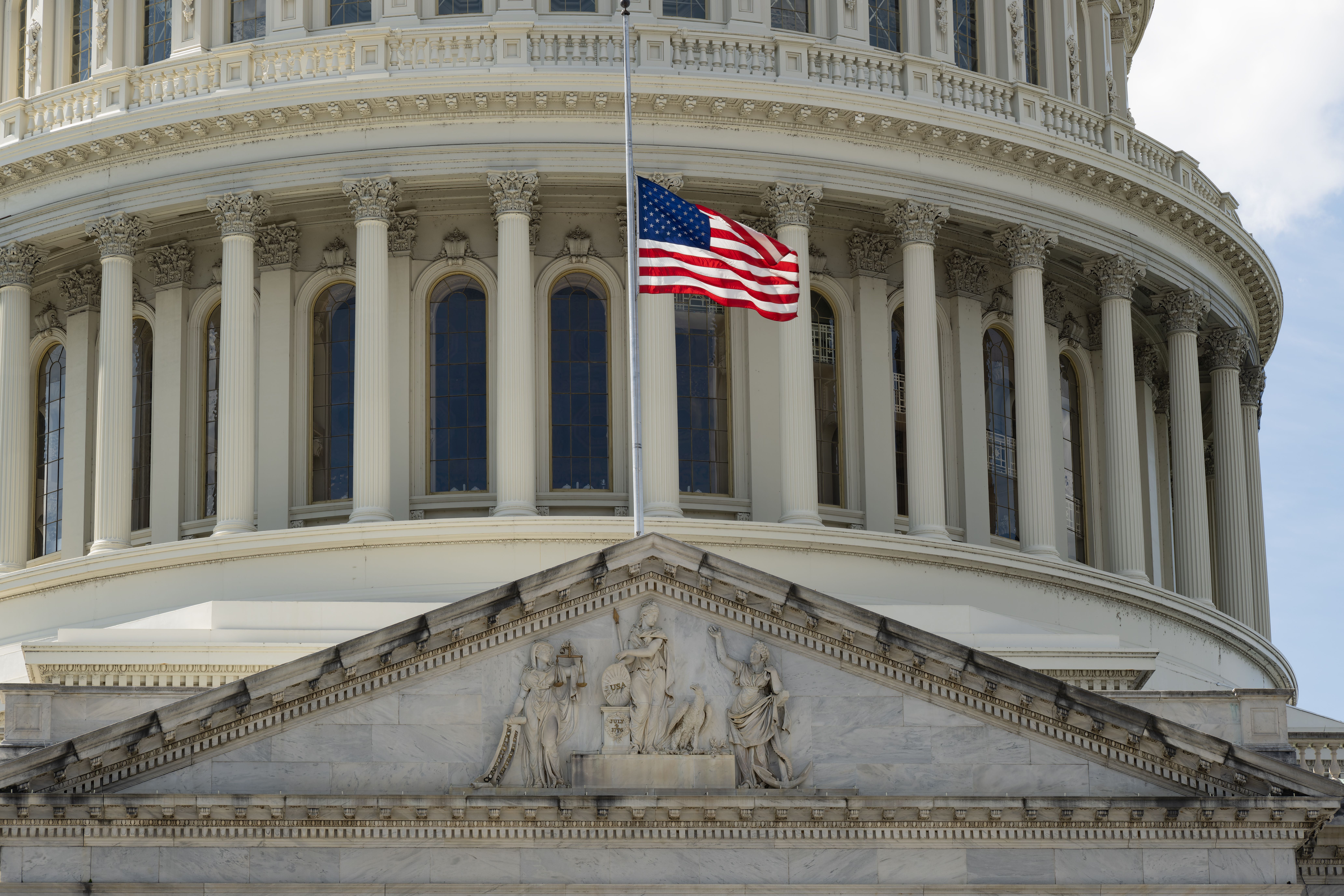
Johnson Scores Commanding Victory in Fight to Advance SAVE America Act Through Democrat Opposition
The $95B budget reconciliation framework includes $10B for states to implement election integrity measures from the SAVE America Act House Speaker Mike Johnson notched a major procedural win this week, steering his plan to advance the SAVE America Act through unified Democrat opposition and a bruising internal battle with fiscal hawks in his own conference. The House Rules Committee cleared Johnson’s budget reconciliation framework Monday, setting up a chamber-wide vote that would tee up passage of one of President Trump’s top legislative priorities — without a single Democrat vote required. Bypassing the Blockade Democrats have refused to support the SAVE America Act, which would require states to verify voter citizenship and mandate photo ID at the polls — commonsense election integrity measures that polling shows are backed by the overwhelming majority of Americans. Rather than let that obstruction stand in the way, Johnson moved to fold key elements of the SAVE America Act into a sweeping budget reconciliation package, a maneuver that lowers the Senate’s threshold for passage from 60 votes to a simple majority, cutting Democrats out of the equation entirely. “Safeguarding American elections and strengthening our national defense are the most basic responsibilities of Congress and are supported by an overwhelming majority of Americans,” Johnson said. The strategy is not without hurdles. Reconciliation rules require legislation to be tied directly to federal spending and revenue, meaning the full text of the SAVE America Act cannot simply be inserted wholesale — the Senate parliamentarian will ultimately decide which election-related provisions can survive under the chamber’s Byrd Rule. To clear that bar, House Republicans structured the package to direct $10 billion to the House Administration Committee specifically to help states implement SAVE America Act-style requirements, such as citizenship verification and voter ID. What’s in the Package The broader $95 billion framework goes well beyond election integrity. It also directs: $60 billion to the Armed Services Committee for military funding, including support amid the ongoing conflict with Iran $13 billion to the Intelligence Committee for defense and Iran-related spending $12 billion to the Agriculture Committee for farm aid, providing relief to American farmers $10 billion to the House Administration Committee for state election integrity grants tied to the SAVE America Act Republicans are framing the package as a three-pronged America First priority: secure the border and the ballot box, rebuild military readiness, and support the farmers who keep the country fed. Overcoming a GOP Revolt Johnson’s win came only after he beat back a revolt from fiscal hawks within his own conference, who balked at nearly $100 billion in new spending with no offsets elsewhere in the budget. President Trump personally intervened to press wavering House Republicans to fall in line, and Johnson has continued working closely with Vice President JD Vance to shore up support. Following a meeting with Vance and House Republicans, Johnson made clear there would be no retreat: “We’re going to pass the SAVE America Act into law, as much of that as possible.” The House Budget Committee advanced the framework Thursday on a 20-14 vote, and Monday’s Rules Committee action clears the way for a full House floor vote before lawmakers depart for their August recess. What Comes Next Passage of the budget framework is only the first step. It directs the relevant House committees to draft the detailed reconciliation text and submit it by September 11, after which the full package must still pass both chambers before reaching the president’s desk. Senate Republicans, including Sen. Mike Lee of Utah — the SAVE America Act’s lead Senate sponsor — have cautioned that the final scope of what survives reconciliation will depend heavily on how the legislative text is drafted and what the parliamentarian allows. Still, Johnson’s ability to unify his conference around a path forward, after Democrats made clear they would offer zero cooperation, marks a significant early win in Republicans’ third use of reconciliation this Congress — and keeps alive Trump’s push to get citizenship verification and voter ID protections written into federal law before the midterms. This story is developing.
Abbott Targets ‘Birth Tourism’ Industry With New Executive Order, Warns Providers Face License Loss
Order directs state agencies to investigate providers accused of marketing birth packages to foreign nationals; critics question both the scale of the practice and states’ authority to regulate it AUSTIN, Texas — Gov. Greg Abbott signed an executive order Tuesday directing several Texas state agencies to investigate what his office calls “unlawful birth tourism schemes” within the state’s healthcare industry, and to take enforcement action — including possible license revocation or contract suspension — against providers found to be advertising, soliciting, or otherwise facilitating them. “Texas will not tolerate the exploitation of our immigration laws by individuals traveling to the United States illegally or under false pretenses to give birth and secure citizenship for their child,” Abbott said in a statement announcing the order. What the Order Does The order directs the Texas Health and Human Services Commission (HHSC), the Department of State Health Services, the HHSC Office of Inspector General, the Texas Medical Board, and the Texas Board of Nursing to investigate allegations of birth tourism fraud and to coordinate with federal prosecutors, sharing information and referring potential violations of federal law. The order builds on a July 7 directive in which Abbott instructed HHSC to investigate Texas hospitals advertising birth tourism packages and refer any state law violations to the Texas Attorney General’s office and local prosecutors. That directive followed reports that Mission Regional Medical Center in the Rio Grande Valley had advertised Spanish-language “birth packages” on billboards in Mexico. The hospital said in a statement that the marketing materials were no longer in use and that it was sharing information about its services in the way hospitals commonly do. According to the governor’s office, HHSC has since referred two Texas hospitals to the Attorney General in connection with the alleged advertising of such packages, some reportedly priced starting around $4,000. The Underlying Legal Debate Birth tourism generally refers to instances in which a pregnant foreign national travels to the U.S. with the primary intent of giving birth so that the child receives automatic U.S. citizenship under the 14th Amendment’s Citizenship Clause. Giving birth in the United States is not itself illegal; legal issues can arise if a traveler misrepresents the purpose of their visit or commits visa fraud, or if a business coaches clients to conceal that intent from immigration officials. The scale of the practice is disputed. Estimates from the Migration Policy Institute put birth tourism at somewhere between roughly 9,600 (based on government data on births to mothers with foreign addresses) and 26,000 births a year — a small fraction of total U.S. births. Some advocates for stricter immigration enforcement argue the figure understates the problem and describe the practice as amounting to citizenship “for sale.” Other legal commentators argue the issue is overstated relative to the broader constitutional question of birthright citizenship, and that it should have no bearing on how the Citizenship Clause itself is interpreted. That constitutional question remains unresolved nationally. A recent U.S. Supreme Court ruling addressed a narrower procedural issue — whether lower courts can issue nationwide injunctions — rather than deciding whether the 14th Amendment guarantees citizenship to all children born on U.S. soil regardless of their parents’ immigration status. Legal challenges on the underlying question continue in federal courts. Texas itself previously attempted to restrict birth certificate issuance to children of parents lacking U.S.-issued identification, a 2015 policy that was later abandoned after legal challenges arguing it conflicted with the 14th Amendment. Broader Political Context The order arrives amid renewed congressional attention to birthright citizenship. Some federal lawmakers have proposed legislation to narrow or redefine who qualifies for automatic citizenship at birth, including measures aimed at U.S. territories and at children of foreign diplomats; other lawmakers and legal advocates oppose such changes, arguing they conflict with longstanding constitutional interpretation. Abbott has said he intends to work with the Texas Legislature to further address the issue and has asked Texans with information about suspected birth tourism schemes to report it to state authorities. This story is developing.

Outbreak On Board: Alaska Cruise Ship Hit with Third Stomach Illness Sweep in Two Months as CDC Review Underway
What was intended to be an intimate, bucket-list voyage through the pristine wilderness of Alaska has turned into a recurring medical nightmare for passengers aboard an expedition cruise vessel. Federal public health authorities have confirmed that the National Geographic Sea Bird—a specialized 62-passenger vessel operated by Lindblad Expeditions—has been struck by its third major gastrointestinal outbreak in less than two months. The latest outbreak, occurring during a five-day voyage between Sitka and Juneau, sickened nearly a third of all guests on board. The repeating pattern of severe illness has triggered a comprehensive review by the U.S. Centers for Disease Control and Prevention (CDC), raising sharp questions from maritime health watchdogs over whether the ship’s sanitation and quarantine protocols are sufficient to stop the virus. At The Modern Memo, we break down the operational profile of the three consecutive outbreaks, the physical environment making small ships uniquely vulnerable, and the regulatory pressure mounting on federal health inspectors to intervene. The Outbreak Timeline: A Summer of Recurring Sickness The primary concern for public health inspectors is not merely a single isolated event, but a persistent, multi-week cycle of infection that has plagued the vessel throughout its summer 2026 deployment. Voyage 1 (Late May): The initial outbreak was logged during a May 26–May 31 itinerary, sickening 9 of 66 passengers and 3 crew members. Stool sample testing conducted by the CDC confirmed the causative agent as norovirus. Voyage 2 (Late June): Less than four weeks later, during a June 25–June 30 trip between Juneau and Ketchikan, the ship was hit again. A second wave sickened 20 out of 95 total passengers and crew, with norovirus once again verified as the culprit. Voyage 3 (Mid-July): The most recent crisis struck the July 10–July 15 sailing. According to official CDC Vessel Sanitation Program (VSP) logs, 18 of the 62 passengers (29%) fell violently ill with severe abdominal cramps and projectile vomiting. While the specific pathogen for the third wave remains under laboratory evaluation, the clinical symptoms match the prior norovirus sweeps. The Transmission Trap: Why Expedition Ships Face Unique Risks While large mega-ships make headlines when hundreds fall ill, small expedition vessels face a different, highly acute set of operational challenges when dealing with contagious stomach bugs. The Math of Small Numbers: Because the Sea Bird carries only 62 passengers, it takes just two or three sick individuals to hit the CDC’s 3% mandatory outbreak threshold. When 18 passengers fall ill at once, it represents nearly one out of every three guests on board, severely straining the ship’s limited medical resources. The Disinfection Gap: Norovirus is a non-enveloped virus, meaning it possesses an extraordinarily tough outer shell. It is largely immune to standard alcohol-based hand sanitizers and can survive on hard surfaces—such as cabinet handles, buffet utensils, and Zodiac boat railings—for weeks unless non-stop, industrial-grade chlorine deep cleaning is applied between voyages. Regulatory Pressure: Will the CDC Issue a No-Sail Order? The frequency of the outbreaks on a single vessel has sparked intense debate among maritime legal experts and public health advocates regarding the limits of voluntary cruise line sanitation plans. Regulatory Step Standard Outbreak Protocol Escalated Multi-Outbreak Action Cleaning Procedures Increase crew wiping of high-touch surfaces with EPA-approved disinfectants. Terminal deep-cleansing using electrostatic fogging and total crew isolation. Passenger Protocols In-cabin isolation for symptomatic guests until 48 hours symptom-free. Mandatory pre-boarding health screenings and stool sample tracking. CDC Intervention Remote tracking via the Vessel Sanitation Program (VSP). Field Response / No-Sail Order: Sending inspectors on board or grounding the ship. Under VSP guidelines, Lindblad Expeditions reported that crews responded by isolating sick passengers, collecting clinical specimens, and executing enhanced cleaning protocols. However, maritime law experts point out that when a single ship suffers three documented outbreaks across a span of seven weeks, standard cleaning during rapid port turnarounds is clearly failing to break the chain of infection. Calls are growing from consumer advocacy groups for the CDC to deploy a full field team to inspect the ship’s water, ventilation, and food-handling networks—or temporarily pull the vessel out of service until a total, uninterrupted sanitization cycle can be verified. Final Word The recurring wave of gastrointestinal illness aboard the National Geographic Sea Bird is the definitive proof that once a virulent stomach bug gets a foothold inside a ship’s tight quarters, standard surface wiping is simply not enough. When you look past the standard corporate press statements about “enhanced sanitation protocols” and analyze the hard data—three separate CDC-tracked outbreaks on a single small vessel in seven weeks, nearly 30% of passengers on the latest voyage struck with severe vomiting, and norovirus repeatedly defying turnaround cleanings—you gain an unvarnished view of an active public health risk. Quality information replaces travel marketing promises with the cold, unvarnished reality of maritime hygiene challenges. Lindblad Expeditions and federal health regulators face an immediate responsibility: either fully halt operations to execute an uncompromised, ground-zero decontamination of the ship, or risk sending yet another wave of paying passengers straight into a floating infirmary.

The Minnesota of the Caribbean: Trump Admin Freezes Virgin Islands’ Funds Over Alleged $10M Hurricane-Aid Abuses
The federal government’s nationwide dragnet against systemic disaster relief fraud has expanded far beyond the mainland, slamming directly into one of America’s most prized tropical territories. In a blistering enforcement action that has sent shockwaves through local government halls, the U.S. Department of Housing and Urban Development (HUD) has officially frozen hundreds of millions of dollars in federal recovery funds earmarked for the U.S. Virgin Islands (USVI). Earning the scathing moniker “The Minnesota of the Caribbean” among federal investigators—a direct nod to the massive, multi-million-dollar fraud scandals that have plagued Midwest social programs—the USVI’s primary housing and development engine has been formally suspended from receiving new federal housing grants. The drastic intervention follows a series of damning federal audits and criminal indictments alleging widespread fraud, rampant cronyism, and the systematic mismanagement of funds meant to rebuild homes shattered by Hurricanes Irma and Maria. With the island territory facing a complete administrative shutdown of its primary recovery programs, the Trump administration has signaled that its zero-tolerance policy for public corruption applies equally to state capitals and territorial municipalities alike. At The Modern Memo, we break down the operational anatomy of the HUD suspension, the high-profile indictments anchoring the criminal charges, and the growing national push to enforce strict fiscal accountability on federal disaster relief. 1. The HUD Freeze: Cutting Off the Virgin Islands Housing Finance Authority The primary weapon deployed by Washington is the formal administrative suspension of the Virgin Islands Housing Finance Authority (VIHFA), the territorial agency responsible for distributing billions in federal recovery and affordable housing grants. The Funding Lockout: HUD’s Office of Inspector General (OIG) alongside senior agency administrators executed an immediate freeze on the territory’s access to the Community Development Block Grant Mitigation (CDBG-MIT) and Disaster Recovery (CDBG-DR) funds. The Scale of Mismanagement: The USVI was awarded over $1.9 billion in CDBG-DR funds following the catastrophic 2017 hurricane season. However, years of unmonitored spending, unaccounted-for contracts, and delayed home repairs prompted HUD to classify the VIHFA as a “high-risk grantee,” stripping the agency of its authority to draw down federal cash without explicit, itemized pre-approval from Washington. The “Minnesota” Parallel: Federal prosecutors and investigators earned the “Minnesota of the Caribbean” comparison due to the striking similarities in administrative negligence. Just as auditors uncovered widespread exploitation of federal food and social service grants in Minnesota due to a complete lack of state oversight, HUD investigators found that USVI officials allowed millions in disaster relief to flow into dubious private accounts with virtually zero financial tracking or performance verification. 2. The Criminal Core: The $10M Disaster Contract Scheme The administrative funding freeze is anchored by a major federal criminal indictment unsealed by the U.S. Attorney’s Office for the District of the Virgin Islands, exposing a multi-million-dollar kickback and fraud ring operating at the highest levels of local disaster management. The Primary Players: Federal authorities indicted Darin Sullivan, former Chief Operating Officer of the VIHFA, alongside Davidson Charlemagne, a former territory government official, and his wife, Sasha Charlemagne. The Storage Contract Scheme: According to court records, Sullivan utilized his executive position to steer a massive, $10 million disaster wood-chip storage and management contract to ISGIX, a private firm connected to Charlemagne. The contract was awarded at drastically inflated rates far exceeding market value. The Kickback Loop: In exchange for greenlighting the lucrative deal and approving unverified invoices, Charlemagne allegedly funneled hundreds of thousands of dollars in kickbacks back to Sullivan through fraudulent “consulting” shell companies. Meanwhile, critical hurricane recovery projects for displaced island residents remained stalled for years. 3. The National Implications: Enforcing Accountability Across the Territories The Trump administration’s decisive move to freeze USVI disaster funds represents a broader, structural shift in how Washington manages federal relief for island territories. Territorial Entity Disaster Allocation (Post-2017) Federal Compliance Status U.S. Virgin Islands (VIHFA) $1.9+ Billion Suspended / High-Risk Status: Funds frozen pending total forensic audit. Puerto Rico (Housing Dept.) $20+ Billion Enhanced Financial Monitoring: Subject to strict federal financial oversight. For decades, federal disaster aid flowing to territories like the USVI and Puerto Rico was treated by local political machines as an unmonitored cash windfall. By applying the same aggressive prosecutorial standards used against mainland fraud rings to the Caribbean, the Department of Justice and HUD are sending an unequivocal message: emergency disaster funds are intended exclusively for disaster victims, not the personal enrichment of local bureaucrats. Final Word The designation of the U.S. Virgin Islands as the “Minnesota of the Caribbean” and the subsequent freeze of its disaster recovery funds is the definitive proof that the era of unmonitored federal disaster bailouts is officially over. When you look past the tropical optics and analyze the hard data—a $1.9 billion hurricane recovery fund compromised by systemic administrative negligence, a $10 million disaster contract rigged to line the pockets of local housing executives, and HUD stepping in to lock the federal vault—you gain an unvarnished view of a necessary intervention. Quality information replaces local political excuses with the cold reality of criminal accountability. Disaster victims in the Virgin Islands deserve real homes and functional infrastructure, not a corrupt local bureaucracy that views natural catastrophes as a business opportunity. By freezing these funds and prosecuting the bad actors, Washington is ensuring that every single taxpayer dollar is accounted for before another cent crosses the sea.